

What is BrainScan?
It’s a simple blood test and detailed report that combines High Sensitivity Plasma Phosphorylated Tau 217 (p-Tau 217), Glial fibrillary acidic protein (GFAP), and Neurofilament Light Chain (NfL) blood tests to detect cognitive decline years before symptoms appear, offering a gentle alternative to spinal taps and costly PET scans.
p-Tau 217
A specific biomarker for Alzheimer-related processes, which is both an early warning for avoiding dementia and for tracking disease progression and improvement.
NfL
A biomarker that tells us whether there is ongoing damage to our brain cells from vascular disease, head trauma, or any neurodegenerative process.
GFAP
A biomarker of ongoing inflammation and repair in the brain.
Note: These tests alone do not provide a definitive diagnosis and should be interpreted in conjunction with clinical signs and symptoms.
When to Consider BrainScan for Your Patients
Routine cognitive testing is advised for patients 35 and older, particularly if they have any of the following risk factors.
- Family history of dementia
- ApoE4
- Memory loss
- Concussion or head trauma
- Social isolation
- Physical inactivity
- Depression
- Sleep apnea
- Mold exposure
- Smoking
- Excessive alcohol consumption
- Heart disease
- High blood pressure
- Obesity
- Diabetes
- Untreated vision loss
- Hearing loss
- Unhealthy diet
- Poor sleep
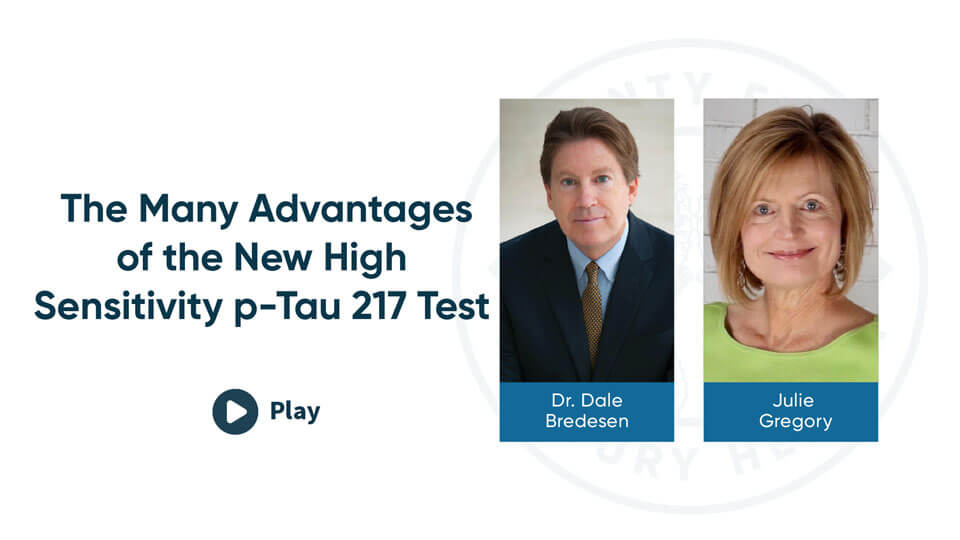
Watch as Dr. Bredesen and Julie G. talk about the importance of p-Tau 217 and detecting cognitive decline early.
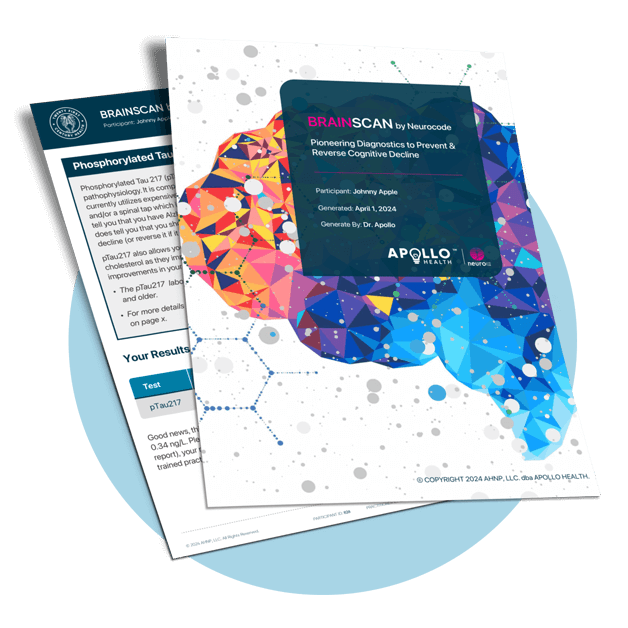
View a sample report.
How It Works for Practices
Doctors may order BrainScan to collect the sample in their office or have a kit shipped to their patient’s home. Results and BrainScan reports are sent directly to your practice.
In-Clinic Draw
$700 + $75 kit fee
Bulk order kits and draw samples in your clinic (best for higher volume and not available in NY).
At-Home Kits
$799
Kits ship directly to the patient; blood draw scheduled via My One Medical Source (MOMS) network. (Not available in AK, HI, NY).
View a sample report.
Common Questions
BrainScan can be ordered by licensed U.S. practitioners and physicians. ReCODE 2.0 training certification is not required to order (Currently not available in New York).
BrainScan is currently only available in 49 US states (Testing is not available in NY, and draws via My One Medical Source (MOMS) network is not available in AK, HI, NY). We are working with our lab partners to make BrainScan available internationally, but currently do not have an ETA for specific locations.
Please stay tuned for updates on our website and in our email newsletters.
No, BrainScan can be orded by any licensed U.S. practitioner and physician.
While the name of the test (p-Tau 217) might suggest that all laboratories that offer this test are the same, Neurocode has performed the most extensive clinical validation and uses the ALZpath version of the test, which has been shown to detect changing pathology years before symptoms show up (Du et al. 2024), providing an opportunity for earlier intervention. The same cannot be claimed by other laboratories. Neurocode has compared the different pTau 217 assays available from other laboratories and has only chosen the best assay to offer. The results of this comparison are under review for publication (Mammel et al. 2024 ).
At this time, these tests are not covered by insurance and are available as cash pay only.
BrainScan helps show where things stand in the brain by looking at biomarkers linked to Alzheimer’s-related changes, brain-cell injury, and neuroinflammation. ReCODE and PreCODE help explore what may be driving those findings and which factors may need to be addressed.
BrainScan uses a highly accurate blood-based biomarker approach that can provide information similar to more invasive or expensive tools, such as amyloid PET imaging or spinal fluid testing. Because it requires only a blood draw, it is far less invasive than a spinal tap and is generally more accessible and less costly than PET imaging. (In some cases, additional testing may still be recommended based on symptoms, medical history, or clinician judgment.)
BrainScan does not diagnose a condition on its own, but it can help reveal biomarker patterns associated with Alzheimer’s-related changes, brain-cell injury, and neuroinflammation. These patterns may help clinicians determine whether further evaluation is needed for Alzheimer’s disease or other possible contributors to cognitive decline, including vascular disease, traumatic brain injury, frontotemporal dementia, ALS, multiple sclerosis, Parkinsonian disorders, stroke, autoimmune or inflammatory brain conditions, or other medical or structural causes. Results should always be interpreted in the context of the person’s symptoms, history, cognitive testing, and other clinical findings.